To advance health equity, St. David’s Foundation centers our work on addressing both individual and systemic barriers to health for individuals whose household income falls below the minimum level necessary for basic survival. We do so with an intentional focus on communities with the greatest health needs, and that includes those that have been historically marginalized, including Black and Hispanic individuals, women, members of the LGBTQ community, refugees, and undocumented immigrants.
We believe that data is an important instrument to help understand who we are, who we serve, and how our investments and programs are making an impact. This demographic dashboard reflects our commitment to health equity and is designed to provide some insight into our work and progress.
Who We Serve
The Foundation’s strategic plan, Pathways to Health Equity, focuses our investments and actions on the communities with the greatest health needs in our geography. The following metrics highlight data on who received funding through our Grantmaking efforts, who received care through our Mobile Dental Program, and the recipients of our St. David’s Neal Kocurek Scholarship Program.
Grant Recipients
We believe that organizations that represent and work within the communities most impacted by health inequities are uniquely positioned to effect change. We are committed to improving our grantmaking practices to center those most impacted by health inequities. We monitor the following metrics and will continue to gather grantee feedback to ensure our funding aligns with this commitment.
Funding to Active Grant Partners:
2025: 195 Active Grant Partners.
Organizations led by People of Color
Definition: More than 50% of the combined count of executive staff and board members are People of Color (defined as non-White)
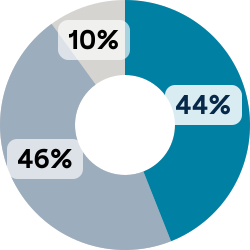
- 44% Majority POC-led
- 46% Not Majority POC-led
- 10% Undisclosed
Organizations receiving a grant for the first time
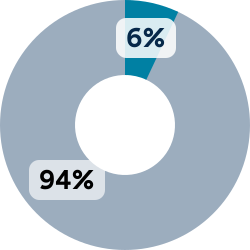
- 6% New Grantees
- 94% Current Grantees
- 0% Past Partners
Organizations by county served
Definition: Primary county of focus as self-reported by the organization.

In 2025, the Foundation’s active grant portfolio included 195 organizations, representing over $218 million in previously awarded funding. This investment represents a $94 million increase in active funding over 2023.
Almost half, 44% or $96 million, of our active funding was invested into 90 organizations that have a majority of People of Color (POC) on their board and executive staff (an increase of 7% compared to 2023). About $13 million, or 6%, of our active grant investments were made to new partners: organizations receiving a grant from the Foundation for the first time (3% higher than 2023).
Additionally, 13% of funding, representing $29 million, was granted to organizations serving Bastrop, Caldwell, or Hays County. This amount closely compares to the 14% of funding allocated to these communities in 2023.
Note that multiyear amounts are reflected within the $218 million total.
Mobile Dental Program
Through our mobile dental program, the Foundation provides free dental care to select Title I elementary school students in our five-county area. As the Foundation works to address health disparities in our region, we continue to evolve our dental program to serve those young patients with the greatest need. We use the following metrics, community data, and feedback to assess whether we are reaching our target populations.
Dental Patients:
2025: 5,683 Dental Program Patients.
Patients with low Income
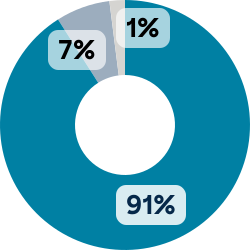
- 91% Eligible for Free/Low Cost Lunch
- 7% Not Eligible for Free/Low Cost Lunch
- 1% Undisclosed
Patients without health insurance
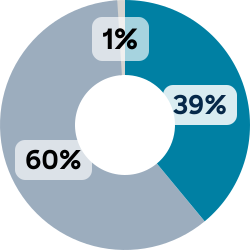
- 39% Uninsured Patients
- 60% Insured Patients
- 1% Undisclosed
Patients who identify as People of Color
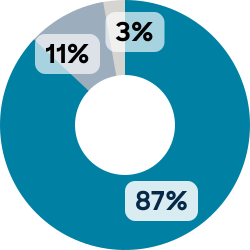
- 87% POC Patients
- 11% White Patients
- 3% Undisclosed
Patients from highest need zip codes
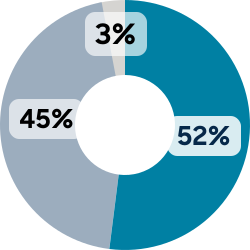
- 52% Patients from Highest Need Zip Codes
- 45% Patients Not from Highest Need Zip Codes
- 3% Undisclosed
In 2024, the Dental Program fully adopted electronic consent forms and began testing new site selection methods to target communities that could most benefit from the program. As a result, the available data on the financial needs of the patients served increased significantly between 2023 and 2025.
In 2025, our dental program served a total of 5,683 patients. Of these, over 5,100, approximately 90% qualified for the Federal Free or Reduced Lunch program, which indicates household incomes below 130% of the Federal Poverty Level. This 90% low-income level is over double the corresponding percentage served in 2023, during which 43% of patients served were low-income.
Approximately 39% of patients reported being uninsured, up from 23% to 2023. Over 4,900 patients, 87% of those treated, were People of Color, with a total of 72% Hispanic or Latino. Finally, 2,900 patients, 52% of all patients seen in 2025, reside in the communities with the greatest health needs.
Kocurek Scholars
The St. David’s Neal Kocurek Scholarship Program aims to support our scholars through scholarships and wraparound services, fostering a robust pipeline of future healthcare workers. Through a merit- and need-based program, we provide funding and other support services to Central Texas students pursuing postsecondary degrees in healthcare. We continue to improve equity in the application process and enhance the diversity of our scholars’ lived experiences. We use the following metrics to evaluate progress toward those goals.
Active Scholars:
2025: 265 Active Scholarship Recipients.
Scholars who are first generation college attendees
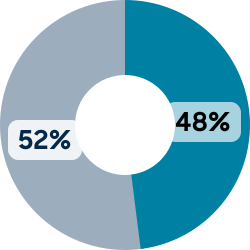
- 48% First-Generation Scholars
- 52% Not First-Generation Scholars
- 0% Undisclosed
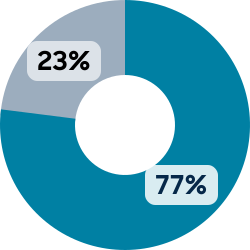
Scholars who identify as People of Color
- 77% POC Scholars
- 23% White Scholars
- 0% Undisclosed
Scholars from highest need zip codes
- 12% Scholars from Highest Need Zip Codes
- 88% Scholars Not from Highest Need Zip Codes
- 0% Undisclosed
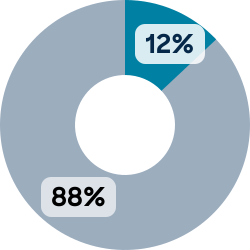
In 2025, the program supported 265 active Kocurek Scholars, providing them with financial support and helpful resources to aid in their academic journey. Of those individuals, 48% are first-generation students (up 17 percentage points since 2023), 77% are People of Color (up 11 percentage points since 2023), and 12% of scholars are from communities with the greatest health needs (See our Health Equity Zone (HEZ) map here). While financial need is heavily considered in our application review process, we have not previously recorded scholars’ household income after the application cycle. We are enhancing our data collection and retention process to collect and report on such information in the future.
Who We Are
We recognize that equity encompasses more than diversity. Yet we believe that collecting and reflecting on data are essential to advancing equity. The demographic information shared below helps us understand who we are across various demographic groups and ensures we promote an institutional environment in which everyone has an equal opportunity to flourish and reach their full potential.
Race/Ethnicity
SDF Board
All SDF Staff Members
SDF Board

All SDF Staff Members

Gender Identity
SDF Board
All SDF Staff Members
SDF Board

All SDF Staff Members

County of Residence
SDF Board
All SDF Staff Members
SDF Board

All SDF Staff Members

We understand that demographics are not limited to these categories, and we strive to be inclusive across all identities and lived experiences. In doing so, we ask our staff, leadership, and board to share their identities and the unique perspectives they bring to their work at the Foundation. Here is just a sample of some of those identities:
Row Text Headline
“I identify as a member of the LGBTQIA+ community.”
“First-generation college student”
“I am a child of an immigrant parent.”
“Caregiver”
“Immigrated to the U.S.”
“Parent of a special needs child”
Last updated April 2026. Data will be updated annually for the Foundation’s Grant Recipients, Dental Program, and Kocurek Scholarships; and biannually for Foundation Board and staff data. View archived data from 2024.